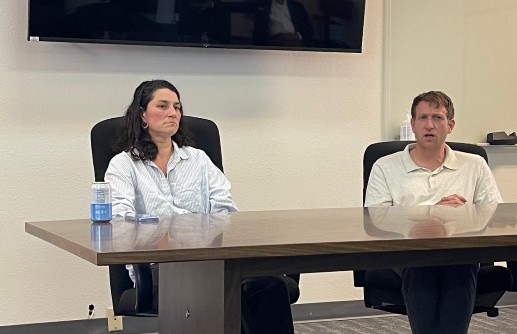
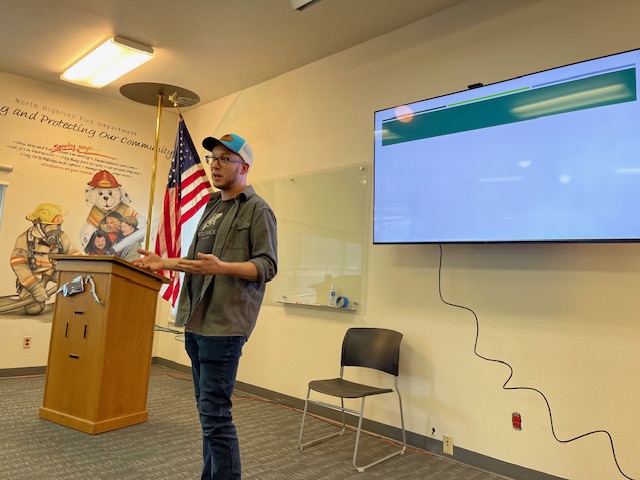
Future changes and improvements from King County was the overarching theme of tonight’s North Highline Unincorporated Area Council meeting, facilitated by NHUAC’s Barbara Dobkin. at the NH Fire Station.
IN MEMORY: Scott Davis, longtime attendee and White Center Kiwanis member, died last Saturday, Dobkin announced. “It’s a big loss for the community.” He had been fighting cancer.
COMPREHENSIVE PLAN: The 2029 “midpoint update” process has begun, said King County’s Erin Auzins. “This is the first of many opportunities in the next two years to share feedback with the county.” The “scope of work” will be recommended to the King County Council in November and the county will finalize it in February.
The comp plan is a state requirement, under the Growth Management Act. This is an “Urban Unincorporated Area.” The plan is supposed to “set policies for growth for the next 20 years.” But “the legacy of annexation hasdisconnected” neighborhoods like this.
Once there’s a plan, it’s implemented by adopting development reulations, and via budgeting.
This is the second “midpoint update,” meant to “address time-sensitive issues that can’t wait until the next 10-year update.”
The scope’s three main areas of focus are Climate Change & Resiliency, including tree canopy, which dovetails with the county’s new Urban Forestry work; Shorelines, which includes streamlining habitat-restoration permitting and review, plus sea-level rise; Housing, including compliance with state-required aspects such as permanent supportive housing, transitional housing, indooremergency housing, and indoor emergency shelters.
Other updates include updating policies regarding surface-water management, open space, road safety, and more, plus work plans dating back to 2024, such as coastal hazards, wildfire risk, communications facilities, and possible map amendments (none in NH, she said).
In Q&A, Dobkin mentioned previous upzones but the lack of some urban features such as good roads, streetlights, etc. “We’re living with rural type standards in an urban area,” including a lack of mandatory trash pickup. An attendee talked about the difficulty of getting from point A to point B.
Another question: Where’s the money for any and all of these changes coming from? The county budget, she said.
Next: The Port continues flying like nothing has changed. But it’s part of the county, right? Yes, she said, but ot mostly does its own thing.
What about housing in cities? Yes,the county and its cities are working together. What about trees – “we can’t just have them in parks?” She replied that the state keeps handing down mandates “and we don’t get to do what we want.”
Another attendee brought up parking shortages. And Dobkin mentioned a need for traffic calming.
Somebody else asked about specific development plans, such as data centers. She said she wasn’t sure about specifics but she hasn’t heard much about interest in those.
Then there was yet another comment about the lack of traffic calming, especially just west of 16th. There was some comparison of notes about neighborhoods, 18th vs. 21st, for example. Daylighting intersections would be helpful too.
Speeding on 26th to get away from newly calmed 16th seems to be common. Lots of complaints about various streets ensued; Dobkin says she’s seen development that doesn’t seem well-planned.
Then there was a question about the next round of “participatory budgeting” (more on that shortly) – the explanation was that the county learned in the previous round that some proposals didn’t work out for a variety of reasons such as the grant-recipient organizations had some changes.
Is the funding from cannabis taxing? Not entirely – it’s from the county’s general fund, and that money is one source for the general fund.
Airport noise came up, and the county rep mentioned that the Port of Seattle is in its own planning-feedback process.
Questions about the comp plan. eauzins@kingcounty.gov or CompPlan@kingcounty.gov
DEPARTMENT OF LOCAL SERVICES: Director Leon Richardson was the other major guest. Road Services is part of his portfolio, and he reiterated its funding challenges, limiting them to only “the most critical things.” He’s hopeful that the new source of funding – $100 million to be raised by a sales-tax increase -will lead to some paving, sidewalks, streetlights in unincorporated areas like this one. “We haven’t been ignoring it; we’ve been limited in our resources.”
Another topic, brought up by an attendee – dealing with dumping. Richardson said they’ve been analyzing the problem to be sure that conditions leading to it can be reduced.
Bong Santo Domingo, who also was there, is Local Services’ rep to this community – you can find him at White Center Library 2-5 pm Thursdays. “I deal with issues, community issues.”
Got a road/sidewalk problem that needs urgent attention? Call Road Services’ 24/7 hotline: 206-377-8100.
Got an issue for sheriff’s deputies – tougher to address now that White Center no longer has a storefront deputy? You might find one at the Log Cabin at Steve Cox Memorial Park.
Dobkin mentioned trying to getsomeone to address an urgent problem in a park and having trouble getting past a voicemail tree; that’s where Local Services might be able to cut through the bureaucracy, Richardson said.
No update on getting WC a dedicated deputy again, though.
An attendee said it’s hard to get onto 16th SW since the recent channelization changes. Richardson said they could have an engineer come out and check the timing among other concerns. 16th at 100th and 102nd are among the spots that need a look.
Phillip from Local Services’ economic development team then ran through some upcoming events, including the White Center Food Bank‘s October 9th event. He also said North Shorewood is organizing a community group.
LIQUOR AND CANNABIS BOARD: The local officer, Erick Thomas, had a few updates (while mentioning his coverage area has expanded further): There’s a new application for a new restaurant/bar on 15th. Quiet summer for complaints until a few weeks ago when four emerged – there’s allege “substitution,” which he explained involving refilling smaller bottles from a large one, which is not allowed; also unlicensed places selling alcohol, and a complaint that an employee was ingesting on the job. He was asked about Whateke, and said they’re changing their business plan to be more family-friendly, which might mean some interior changes. Another establishment – too soon to name, he said – is considering something similar.
NEXT MEETING: First Thursday in November (which will be the 5th).
August 30th, 2026 Tracy Posted in North Highline UAC, White Center newsComments Off on THURSDAY: Checking in with the Comprehensive Plan, plus Director of Local Services, @ North Highline Unincorporated Area Council
Lots of community information – and opportunities for questions – coming up Thursday when the North Highline Unincorporated Area Council reconvenes for fall. Here’s the announcement:
The Opportunity to Be Informed, Be Involved, and Be Heard
At the North Highline Unincorporated Area Council (NHUAC) Meeting!
When: Thursday, Sept 3rd @ 7pm
Where: North Highline Fire Station in White Center
1243 SW 112th Street (Parking and Entrance are in the Back of the Station).
Hope everyone is well and enjoying these wonderful late summer days. We are happy to be back and look forward to seeing you on Thursday, Sept 3rd. when we will be hosting Regional Planning Manager Erin Auzins. Erin will provide information and updates on the scope of work for the 2029 Midpoint Update to the Comprehensive Plan.
“The King County Comprehensive Plan is the main policy document that guides land use, growth, and regional services in unincorporated King County. It acts as a long-term roadmap to comply with the Washington State Growth Management act.”
What the Plan Covers
Land Use: Decides where homes, offices, and stores can be built, and sets boundaries for rural and urban growth.
Regional Services: Guides county investments in transit, sewers, parks, trails, roads, and solid waste.
Environment & Resources: Protects working farms, forests, clean air, and clean water
We are also pleased to host the Director of Local Services (DLS), Leon Richardson. In way of history, in 2019 DLS began with the goal of developing “new and better ways to serve” unincorporated King County. DLS is responsible for providing essential services such as permitting, zoning, road services and code enforcement, all important issues for our community.
Thanks to everyone for showing up and supporting your community.
What was supposed to be a conversation with all three 34th District state legislators at last night’s North Highline Unincorporated Area Council meeting was instead a conversation with two – State Rep. Brianna Thomas did not attend, but State Sen. Emily Alvarado and State Rep. Joe Fitzgibbon did.
MNUAC’s Barbara Dobkin asked each to talk about themselves first.
SENATOR ALVARADO: She’s been in the Legislature for four years – two in the House, two in the Senate. Outside the Legislature, “my background has been mostly in affordable housing.” She moved to Washington to go to law school but found herself diverted into the housing sector. She now works (remember, state legislator is supposed to be a “part time” job in our state) for a nonprofit and is vice chair of the Senate Housing Committee and also has a role on a committee that deals with liquor, cannabis, and labor issues. She’s also on the Transportation Committee, which means that part of her district – Vashon Island – has a voice in the state ferry system on which it so deeply depends. She works on family and child-care issues – she has a 14- and 10-year-old – and she says you might be startled to hear that child care is more expensive than college. She’s a West Seattle resident but says she has spent a lot of time in North Highline. “A not insignificant part of our district is unincorporated,” so she hears that the state matters more here “because you don’t have as many other levels of government otherwise.” SO, she says, she tries to pay extra attention to issues involving people here.
REPRESENTATIVE FITZGIBBON: He’s been in the Legislature 16 years and has lived in Highland Park (West Seattle) for seven years, after previous residences in the West Seattle Junction and Burien. “I do think we have an extra need to hear from folks in (the unincorporated) areas,” for the same reason Sen. Alvarado had cited. His biggest focus has been on environmental issues, and then he was elected House Majority Leader, so an even bigger focus has been on budget issues including education. “It’s been a challenging time for the state budget.” he noted. “How do we protect and grow the role of the state in supporting people who rely on (it)?” including students and seniors. Child care has been a big issue for him, with a 2-year-old and three-month-old. “We’re fortunate we have a lot of family help” but that’s not available to many families, so the state has increased its support for families who need child care, he said. He said that he’s proud to be involved with the White Center community. He also said he was sorry to hear of the late NHUAC leader Liz Giba‘s death (mentioned in our report on last month’s meeting).
Q&A: How is Medicaid going, given the federal cuts? Dobkin asked. Fitzgibbon said Medicaid has always been a state/federal partnership. “One of the things we have to spend a lot of money on right now is to set up new eligibility systems, the goal of which is to kick people off Medicaid, which is frustrating because we had been going the other direction.” He says he’s hopful “some of those changes may be undone” if Democrats take back control of at least part of the federal government. He said it’s also frustrating that they’ve tried to strengthen the safety net but that too has run up against federal budget cuts.
Attendee’s question: This attendee actually read a statement related to the Citizens’ United decision and a bill, SB6358, and whether the reps would support it. Alvarado tried looking it up and said she would want to know more before committing but is fully supportive of undoing Citizens United, saying what’s happened since it “is terrible.” Fitzgibbon said he’d want to understand more about the language of the bill before committing to it, but agreed “we are not well-served by moneyed interests in politics.” He said Citizens United didn’t change much about Washington campaign law but yes,, he agreed that “to prevent that type of oligarchic spending is necessary.”
Followup on the Medicaid matter and SNAP changes: The feds said they wanted to kick undocumented immigrants, fraudsters, etc., off the rolls, so has the state found much of that? Fitzgibbon said “no.’ One thing, he said, is that if the error rate was over six percent, the feds would take away more. Our state has one of the lowest rates in the country and most errors are the feds’ fault.
Alvarado added, “There’s a lot of misinformation.” And the state will have to find a way to provide coverage to those who are losing it.” She mentioned her proposal dubbed the “Wal-Mart tax” last session; “there’s no great place to go for revenue but we try to do what we can.”
Fitzgibbon added that one of the reasons the bill died was that there was no way to verify what percent of a company’s employees was on Medicaid/SNAP, and that too related to the feds’ attempt to find more ways to kick people off the assistance.
Another attendee said he was concerned about the two parties endlessly fighting as well as a lack of clarity when people mention “immigrants” without saying whether they’re referring to legal or illegal immigration.
Fitzgibbon clarified that undocumented immigrants are not eligible anyway, even though many of them pay into it.But if they’ve been in the country with legal status, for them to be kicked off health coverage is wrong; they’ll wind up in emergency rooms, at higher costs.
Alvarado then clarified that most of what the state Legislature passes is bipartisan – “we do get a lot done here, together.” But the federal discourse on immigration is making things worse, and they can’t do much about it, since it’s a federal matter.
How to get enough money for education and child care? another attendee asked. Sen. Alvarado said that even passage of the millionaires’ tax still leaves us as the “47th or 48th most regressive tax state.’ If that were fixed, the state might be collecting $3 billion a year. She said she would turn some taxes down if others could be brought up. And it’s difficult to realize that when the state is facing another deficit.
Fitzgibbon said that any tax increase, even in this very-progressive district, tends to create a lot of anxiety as the pressure ratchets up on people’s resources. We offer people a lot and its cost keeps going up, like “generous” student aid. He said that if he were in charge, he could imagine a better tax code like say the one in place in Idaho, which has “a low sales tax, a low income tax …” But they have some things to draw on, such as the pension fund “windfall,” he added, and hopes “to put some of that money aside to bring costs down.”
Alvarado noted that “we all pay our federal taxes” and most of it “goes to defense and war” while the taxes we pay here “goes to pay our teachers … health care is the next bucket.” Half of state taxes go to education, Fitzgibbon declared. “There are cuts we could make,” he said – “reductions in services for the developmentally disabled,” done in a larger institution while he feels it could be better done in smaller facilities, but there wasn’t much support for it. He said there’s not enough “waste” to make a difference.
“It’s not like there are pots just sitting there being misspent or missing,” added Alvarado. There’s already been personnel cuts, though “the people are the services (so) when you cut staff, you cut services.’
Another attendee brought up the ferries that are being built out of state. Fitzgibbon noted that there are very few Washington shipyards that can build ferries. At least they have to be built in the US; Canada, for example, has its ferries built in Romania. The discussion that ensued highlighted that “there’s a constituency for every possibility” – for some the lower costs matter most, for others having them built here and benefiting local workers and companies mattered more, etc. They also discussed the staffing situation’s improvement (as ferries executives spotlighted at last week’s online community meeting).
What about light rail funding? was the next question. Fitzgibbon said he felt West Seattle was better positioned because of the bureaucratic hoops that already have been jumped through; Ballard, more difficult, in part because of the 75-year financing issue. (He didn’t address whether that had a chance if it were reintroduced.) As for continuing beyond West Seattle and heading to White Center and Burien, “I don’t think we have the answer yet.” Fitzgibbon said, “MY benchmark is that by the time mm 3-month-old starts elementary school, I think we’re going to have light rail to West Seattle.”
Dobkin asked about whether federal attempts to go after mail-in ballots are threatening our elections. Alvarado said there are certainly threats but we could re-orient people to use drop boxes if the ruling on postal-mail ballots stood; that still would only affect federal elections, we could still handle state elections the way we want to. (A side conversation about the merits of mail-in voting ensued, including the joys of sitting at your dining table and looking up issues and candidates while you vote.) Fitzgibbon said the biggest threat we face is if the court says ballots have to be received by Election Day, not just postmarked by then.
On public-safety issues, Dobkin mentioned that a newspaper article about crime trouble on north Seattle’s Aurora Avenue had outlined legislators passing a bill that was supposed to enable respite centers for sex workers. Alvarado said “I don’t want to be a state where the only tool to help people who’ve been trafficked is to be arrested … We have to fund (interventions) too.” She also cautioned that she isn’t an expert on the issue so she doesn’t know if SPD needs to do things differently, but she’s not comfortable suggesting that we need to move back into decriminalization. Fitzgibbon said the legislator mentioned in the story is an expert in the area. Alvarado said the Legislature tried to “help and offer some supports” by enabling local jurisdiction to implement an extra sales tax.
Might the feds go through with the possible threat to halt international flights to sanctuary cities? “I think it’s the kind of crazy thing we see every couple days,” observed Fitzgibbon, also pointing out that Sea-Tac Airport is not in the city of Seattle.
Dobkin then asked what the state could do about homelessness response, and noted that Myers Way is seeing an increase in RVs.
“Homelessness is certainly a big topic,” said Alvarado, adding that “everywhere in the country is feeling the impact of homelessness … largely because housing is so unaffordable. .. Chronic homelessness is increasing because people are out there longer.” More needs to be done, she said, and added that shelter beds are fewer than what’s needed, and that it’s still hard to find sites, raise money to run them. The state funds both shelter and supportive-housing operations, she said, adding that last year they passed legislation to make it easier to open new shelters. She also brought up the “continuum of care funding” attack from the feds, which would have pulled funding for running some of the housing that’s already open. But they’ve had to “hold back” some mone to have it in reserve for running it in case the feds try again. She added that the fastest-growing segment of the population experiencing homelessness is older adults. “I’m scared of what we’re going to see in the coming years” if that’s not addressed.
She added that there was some expansion of tax credits for seniors who own homes, though.
What about people who need but decline services? Alvarado says that’s mentioned anecdotally but it’s important to offer people things that meet their specific needs, and then most people will accept it.
Shortly thereafter, the conversation wrapped up – “we’ll do it again next year,” Dobkin promised the legislators.
LOCAL SERVICES: Economic Development’s Phillip Le spoke, saying lots is going on in downtown White Center, where those new lights will be on earlier as it gets darker. How are they funded? Dobkin asked. Originally set for participatory-budgeting money, they were instead bought and paid for by the Roads Division, he said. He also mentioned the June 26th World Cup watch party that will close 16th. They’ll be packing up about 7 pm so they won’t show the last match of the night. They also are hoping that the south end of Delridge on the Seattle side will be able to shut down and be part of it too. Le also mentioned a housing survey that the county is circulating right now. The graffiti marring the ex-Bartell Drugs at Roxbury/15th came up; Castillo’s, the building’s owner, is working on the inside, he said, and will clean up the outside when they’re getting closer to opening a new market. Lots of other business spaces were discussed; nothing dramatic and new yet. In some cases, businesses that had received help to reopen still need to rustle up money due to rising costs. He’s also looking for spaces for a robotics group to meet, as it’s in a space where it’s about to get displaced.
NEXT NHUAC MEETING: The organization’s summer break starts now, and the next meeting will be in September or October.
May 31st, 2026 Tracy Posted in North Highline UAC, White Center newsComments Off on Talk with your 34th District state legislators at North Highline Unincorporated Area Council’s June 2026 meeting
Ms. Giba’s longtime fellow NHUAC leader Barbara Dobkin said that though her death in March followed “a long illness .. it was still a shock. Liz meant a lot to the community.”
(2010 photo by Dina Johnson for WCN)
Dobkin recalled Ms. Giba’s battle to recover from a “pretty massive stroke” almost a decade and a half ago. “She really was tenacious … I talked to her about a week and a half before she died, and she was talking about (coming to) this meeting. Nothing could slow her down.”
Her community service spanned beyond NHUAC, too, including service as a North Highline Fire District commissioner. Dobkin vowed that NHUAC would carry on, and also noted that the rest of the night’s agenda “is a wonderful tribute to her,” including causes and issues about which she cared deeply.
Here are the highlights of what followed during the NHUAC meeting:
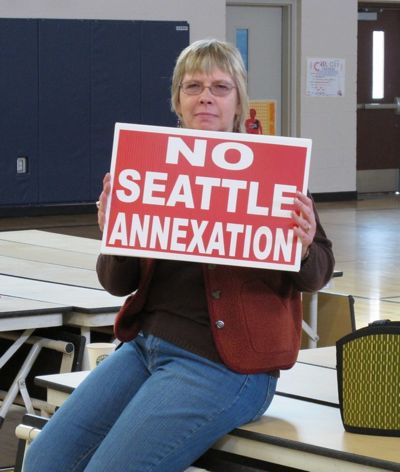
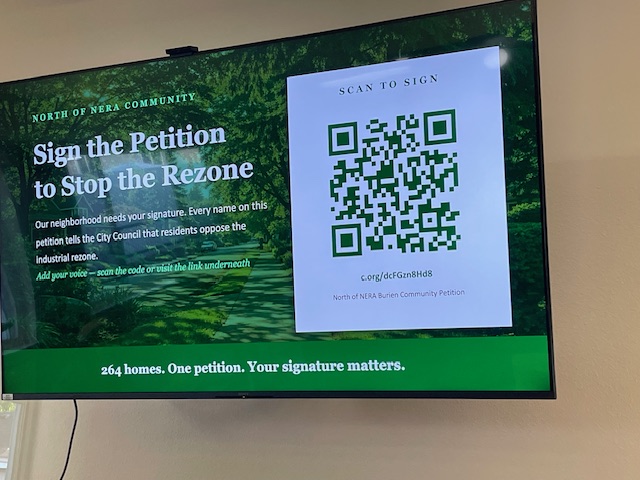
DEFENDERS OF HIGHLINE FOREST: A representative of this group explained that it began as “Save North SeaTac Park.” The port was potentially going to build a parking garage in the middle of heavily treed land. That’s how the defenders got going, and they seem to have won, it was explained. Now they’ve rebranded as Defenders of Highline Forest to focus on other development/rezoning issues that she said pose a threat to “mature trees and tree canopy.” For example, there’s a Burien rezoning plan described as between 128th and 138th west of Des Moines Memorial Drive, with the possibility of an “industrial rezone” and a Planning Commission hearing coming up July 8, with a petition drive under way to oppose the rezone.
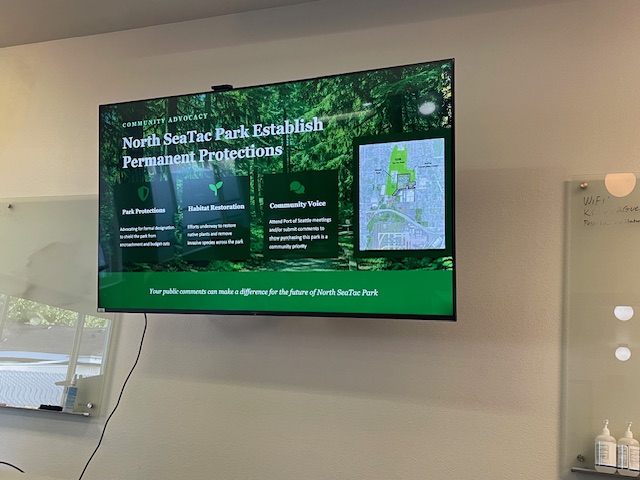
The group also wants to establish permanent protection for North SeaTac Park, believing that what they’ve won could change quickly, and sensing some reticence on the port’s part, so they’re seeking community support.
That includes keeping watchful eyes on the Sustainable Airport Master Plan, which includes dozens of future projects, some of which the group worries could affect greenspace as well as raise new noise issues.
Release of the plan this past Friday opened the comment period – you can read more about it here. The Highline Forest group an others are hoping to have an event of their own soon.
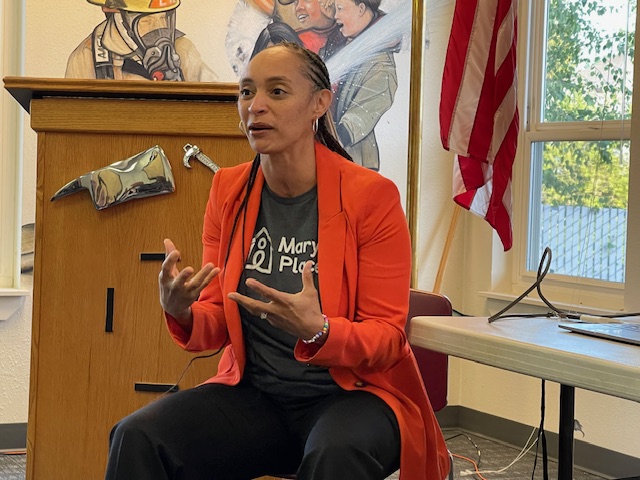
MARY’S PLACE: CEO Dominique Alex was a guest.
She briefly recalled the former White Center shelter site – part of the King County building that formerly stood where the HUB is now – and said they’re excited about their latest Burien project. She outlined what MP is doing now – they have two shelters in downtown Seattle, and are building one in Burien. Sixty percent of Mary’s Place clients are kids under 18; 88 percent are BIPOC; 54 percent of the moms they serve are single. The organization has behavioral-health specialists and outreach to families as well as prevention like rental assistance. MP operates an emergency intake line – 50+ families with children call daily – but there’s only enough shelter space for 2-3 families a night.
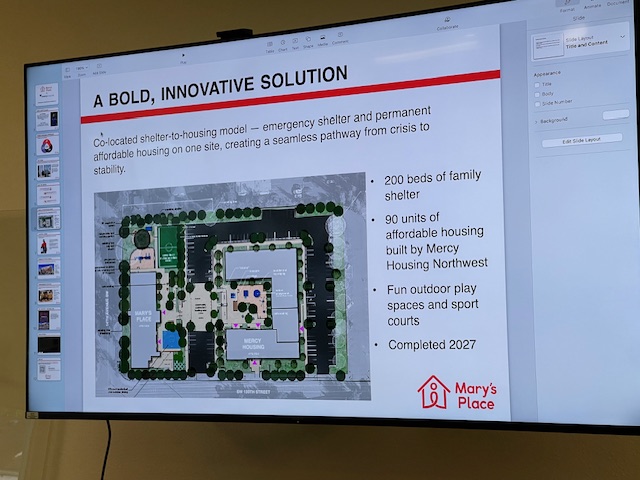
The Burien project, Alex explained, is their new campus at 130th/Ambaum, to include a 200-bed, 4-story shelter, as well as 90 units of affordable housing being built by Mercy Housing Northwest. The project is due to be complete next year. Placing housing, shelter, and wrap-around services with “many partners coming in” to provide will make it unique, she added. Even the food situation will be unique – culturally responsive meals provided as well as space for clients to cook their own meals. Best of all, Alex continued, they have raised $37 million for all this, with only $1.2 million left to raise (as of the meeting night in early May).
WHITE CENTER FOOD BANK: Randy Nguyen said they’ve paid off the “new” building, open five days a week for food distribution. They’re seeing about 300 customers a day. Also increased, staff size and their budget. They’ve gone through a strategic planning process, and they’re dedicated to the fact that “Food is a human right.” They cleaned 40,000+ pounds of produce last year! WCFB also buys 17 percent of its produce from local BIPOC farmers.
Current challenges: Federal cuts have affected the food bank – less meat, less AmeriCorps help. And with a lot of ICE activity, that’s meant fewer Spanish-speaking clients
Also, the huge jumps in gas prices have affected produce pricing – $800 to $1200 a day, double/triple what it used to be.
NHUAC meets many months on the first Thursday, 7 pm, North Highline Fire Station, 1243 SW 112th. They’re looking for volunteers too – potential board members!
May 3rd, 2026 Tracy Posted in North Highline UAC, White Center newsComments Off on North Highline Unincorporated Area Council invites you to May 2026 meeting on Thursday
The Opportunity to Be Informed, Be Involved and Be Heard
At the North Highline Unincorporated Area Council (NHUAC) Meeting!
When: Thursday, May 7th @ 7 pm
Where: North Highline Fire Station in White Center
1243 SW 112th Street (Parking and Entrance are in the Back of the Station)
Plan on joining NHUAC for an informative meeting where we will hear from the organizations who make a difference in the lives of North Highline Residents.
Noticed a need for more trees in North Highline? Sandy Hunt will share her perspective and the work that the “Defenders of Highline Forest” are doing to preserve and add to these precious resources.
Curious about the construction going on off Ambaum at 130th Street. Well, the exciting news is that the family shelter, Mary’s Place, is developing a unique campus of co-located permanent affordable housing alongside a new shelter facility at this site. Chief Executive Officer, Dominique Alex will be on hand to provide updates and information about this exciting addition to the Highline Communtiy.
Food Banks play a key role in making our food systems stronger. They help provide a local food source for communities and, especially during tough times, make sure fewer people go hungry. After years of being located off 108th Ave, the White Center Food Bank moved to 16th Ave in the heart of White Center and continues to play an important role in the community. We are pleased to host Randy Nguyen, Marketing & Community Engagement Manager of the WC Food Bank, who will provide updates and ways that we all can contribute to this important organization.
Knowledge Is Power
Learn, share, and help make North Highline a healthier community.
March 30th, 2026 Tracy Posted in North Highline UAC, White Center newsComments Off on North Highline Unincorporated Area Council canceling April meeting
As always, plenty of new community information emerged when the North Highline Unincorporated Area Councill hosted its first meeting of 2026 last Thursday at the North Highline Fire Station.
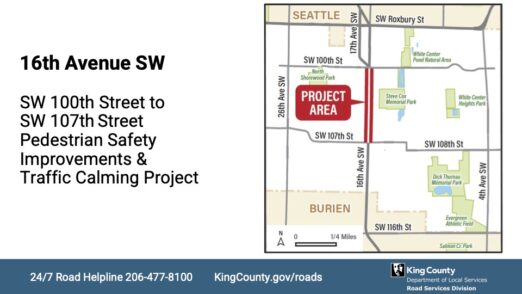
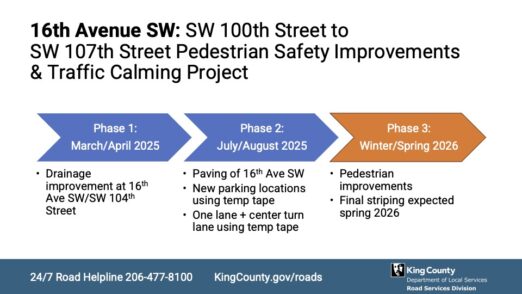
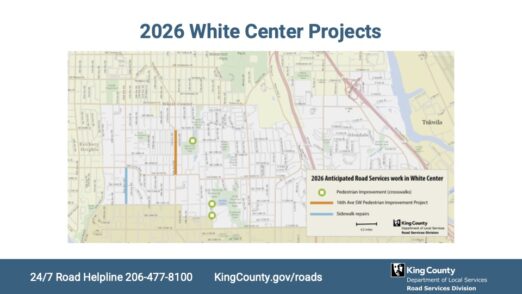
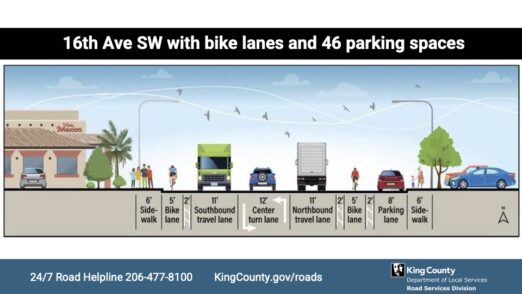
ROAD SERVICES: A trio of King County Road Services reps came to talk about the 16th SW project and what else their department is doing in the area in the months ahead. Here’s their full slide deck – key points below:
Amy Breslear said the 16th SW work from 100th to 107th has been planned in three phases – the 16th/104th pipe replacement, the rechannelization, and now the pedestrian improvements, with final striping expected in spring.
What’s left? Bulbs are going in now, then pedestrian pushbuttons will be added, as will the bike lanes.
Other upcoming WC projects: 26th SW sidewalk repairs to fix tree damage and give trees room to grow; plus projects in spots near Steve Cox Memorial Park (pushbuttons) and near Evergreen High School and Cascade Middle School (raised sidewalks).
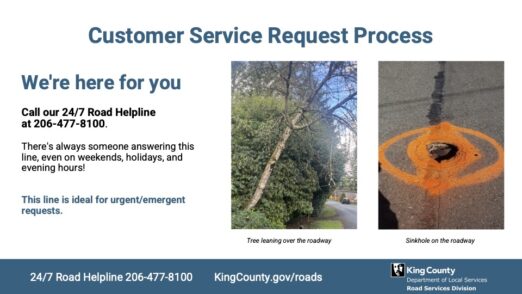
Lilli DeLeon from customer service said you can send requests through the 24/7 helpline – someone answering at all times at 206-477-8100, optimally used for urgent issues like a leaning tree or sinkhole. For non-urgent problems, maint.roads@kingcounty.gov It’s checked M-F, 7 am-3:30 pm.
Best practices for complaint info: Be sure you’re ready to provide contact info, which side of the road, photo or video, exact address – all that will help accelerate the processing. Once you make a request or report, a “service request” is created, a work unit is assigned to investigate.
DeLeon also had a pie chart showing that 480 service requests had been made and closed in this area last year. Illegal dumping was the most common complaint. Do you install “no dumping” signs? someone asked. Breslear wasn’t so sure that would be a deterrent, but suggested requesting it anyway.
Another attendee mentioned a roadside ditch – no curb – that she’s reported repeatedly, along with a fire hydrant that’ in dangerous enough to be in danger of getting hit. Breslear suggested the attendee send in the address for investigating, because it might be on private property, but they’d have to check. Someone else noted that Seattle has a lot more signage, more structures like traffic circles, etc., just over the line north of White Center. “Why don’t we get the same urban treatment that Seattle gets? I feel like White Center shouldn’t be treated differently.” Amy said that new leadership in the county and Local Services might be an opportunity for things to be reconsidered. But it was noted that structures like the stop sign at Delridge/Cambridge (in the city) don’t always improve everything. The flashing-light stop sign by McLendon and Steve Cox seemed to, though, said the attendee. Concern for pedestrian safety was voiced too, as were some other problems – a pothole on 106th, for example. What about areas where asphalt repaving is needed? Amy said those too should be repaired “so we’re happy to come out and look at it,” though funding is tight. Another attendee said the 112th crosswalk is much appreciated.
On a semi-amusing closing note, the Road Services team brought some swag including a brochure about their snow/ice response. “But that’s not happening this year, I’ve decided,” Breslear joked.
KING COUNTY SHERIFF’S OFFICE: Major Coby Hamill, Southwest Precinct commander, was a surprise but welcome guest. He said he had “good news” – in recent months he’d heard a lot of concern about an increase in White Center crime, so they took extra action. For background, the Sheriff’s Office is still short 112 deputies out of 800, “a pretty good chunk of vacancies we have” – the retirement wave is hitting too – “as fast as we’re hiring, folks are retiring” – his staffing is still at 70 percent and they still don’t have the staffing to bring back the White Center storefront deputy. He did bring on a traffic deputy, who is a winner of KCSO Deputy of the Year, Deputy Manjot Singh, whose twin brother works in Burien. He’s been on since April and has made 700+ traffic stops, close to 100 DUI arrests, written about 700 traffic tickets, 100 criminal citations, 50 or so criminal arrests including “some with guns,” and handles abandoned vehicles so that doesn’t take a patrol deputy away … even vehicle-collision investigations. “He’s doing amazing work,” Maj. Hamill enthused.
Now the announcement – he said that after meeting with community members and others who were worried they don’t often see deputies – there are still two covering this area – Maj. Hamill asked the detective sergeant for support, so they brought out an emphasis patrol earlier that day (Thursday, February 5) close to 12 deputies, undercover detectives too. They took 12 people into custody, had “4 more charged via investigation, 45 total contacts in 4-hour period, cited somebody riding a 4=wheeler iproperly” … Maj. Hamill said 60 percent of the day’s arrests were for warrants, 40 percent for on-view including Metro bus stops – participating officers included Metro Transit Resource Officers as well as Bike Squad deputies. He said they’ll do this again on occasion throughout the year, “most of these people were on duty anyway.”
Here’s a doc with the latest crime stats – throughout all three areas, is crime down 24 percent, though some categories like shoplifting have gone up a bit, the emphasis patrol arrested somebody who’d been stealing at Dollar Tree. But the traffic deputy is the big win, he said, for violations including abandoned cars, “they’re taking those outo daily.”
(Side note – reporttosheriff.org is a way to report crime online, provided it’s not urgent/happening now, in which case definitely call 911.)
What about law-enforcement involvement with schools? Resource officers were eliminated so aside from responses to crime reports, not a lot. Maj. Hamill expressed distress about the deadly shootings in Seattle recently, noting that KCSO “got the call initially” because it happened at a bus stop. Why were the resource officers eliminated? He said people were “mad” at law enforcement back around the 2020 George Floyd murder, “sometimes that happens,” though he wished they still were part of the force so kids could have positive exposure to police early.
Does the KCSO have a gang unit? No, they haven’t had money for most specialty units for a while. Also, he said in response to questions, gang activity is dramatically less than it once was. “It’s still out there” but “it’s nowhere near as frequent as it used to be.”
ECONOMIC DEVELOPMENT:Phillip Le chatted informally with the board. He said there’s a new ice-cream shop set for the renovated storefronts on the fire-damaged side of 16th SW south of Roxbury. He said the former Chase Bank building is a target for efforts to activate empty spaces – artist showcase, music – County Councilmember Teresa Mosqueda is pushing for activation of empty spaces. Le said he spends most of his time supporting businesses “so they can stay in White Center” and also via beautification that helps them keep customers coming back.
LIQUOR AND CANNABIS BOARD:Eric Thomas was there for the first time in a few meetings, saying there had been some reorganization a few months back. Now they cover King County with four officers; used to be six; Skyway and Tukwila are now in his portfolio as well as White Center, Burien, and Normandy Park. “Any business that sells liquor directly to the public is my responsibility,” he explained – public safety being the priority – when someone asked exactly what he does. He just offered some general discussion such as that he stresses education rather than punishment. And if you think you know of an establishment committing violations, let the LCB know!
FUTURE TOPICS: What would you like to see NHUAC meetings cover? Board members can schedule topics and invite guests – just let them know what interests you! You can contact the board here.
January 31st, 2026 Tracy Posted in North Highline UAC, White Center newsComments Off on THURSDAY: Road projects, crime stats on the agenda for first North Highline Unincorporated Area Council meeting of 2026
North Highline Unincorporated Area Council Meeting
The Opportunity to Be Informed, Be Involved and Be Heard
When: Thursday, February 5th at 7 pm
Where: North Highline Fire Station Meeting Room, (Parking and Entrance Are Behind the Station)
Greetings and hope everyone is having a good start to 2026.
NHUAC is happy to be back with our first meeting of the new year.
If you have been wondering about all the road work taking place on 16th Ave, now is your chance to find out. We are pleased to be hosting Amy Bresslour, from King County Road Services Division. She will provide updates not only on the 16th Ave project, but also on other planned projects in North Highline. Come prepared because there will be plenty of time for questions.
At the October 2025 meeting we heard from Sheriff Patti Cole-Tindall, who noted that KCSO staffing is still “challenged – 100 vacancies out of 805.” With that said, the White Center Storefront Deputy position remains vacant, but has been promised to be filled when staffing improves. Of course, there are always deputies covering North Highline, and we were reminded to call 911 to report emergencies. Nate Hammock, White Center CSO, provided NHUAC with the most recent crime stats that we will share at the meeting.
Thanks to everyone for showing up and supporting our community.
See you Thursday, Feb 5th at 7 pm.
Questions: Contact bmdobkin@gmail.com
The NHFD station is at 1243 SW 112th in White Center.
First Thursday of the month is usually when the North Highline Unincorporated Area Council convenes an information-filled community gathering. But not this week, nor the rest of the winter. Here’s the announcement NHUAC sent us to share with you:
North Highline Unincorporated Area Council will not be holding a November meeting. We will be taking a winter break and will resume meetings in February 2026.
In the meantime:
Thanks to everyone who attended the informative Oct 2nd NHUAC meeting with guests, King County Sheriff Patti Cole-Tindall and King County Executive candidates Claudia Balducci and Girmay Zahilay. If you missed the meeting, please see the excellent report and video from whitecenternow.
Election Day is November 4th. The ballot drop box has moved from the White Center Library to Steve Cox Memorial Park.
Road Concerns: Contact King County 24/7 Road Helpline @ 206.296.8100
To report Illegal Dumping: Contact King County Illegal Dumping Hotline @ 206.296.7483
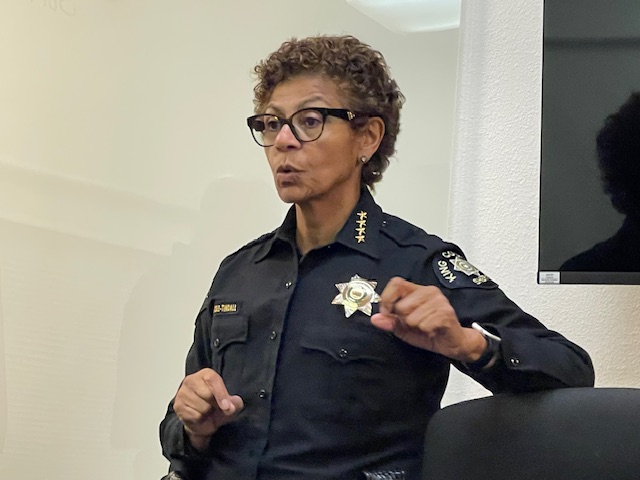
KING COUNTY SHERIFF: Sheriff Patti Cole-Tindall was first up. Regarding the storefront deputy, she said KCSO staffing is still “challenged – 100 vacancies out of 805.” They’re doing some “creative recruiting” with “incentives,” currently focused on in-state laterals, “people who can get up and running very quickly,” two to four months. She mentioned the recent 40-40-40, $40,000 signing bonud, 40 hours sick leave and 40 hours vacation from the day they start. Recruits also get to ask for specific work locations. If they’re trained in a specialty, they can compete for similar jobs. “We’re trying to incentivize these experienced officers to come.” As of two weeks ago they had 16 applicants: “We’ve got a hill to climb” … and once there are some new hires , then they can talk about a storefront deputy. Major Koby Hamill of the Southwest Precinct says he’s at 70 percent staffing, short about 12 deputies. He’s approaching two years at the precinct and has lost the storefront deputy in Skyway. He said they train people so well that theirs get poached, both internally and externally. Filling the White Center storefront spot “remains high on my list” but he has to be fully staffed for 911 calls as first priority. One thing: “I did carve our a traffic deputy” for this area, one at day, one at night, but they serve Skyway, Vashon, and WC.
Attendee question: Has the restriping of 16th affected things? “I was impressed,” said Hamill.
Cole-Tindall reiterated that the storefront deputy position will be filled, “we’re just looking at when.” The sheriff then mentioned the sales-tax increase that the Legislature is allowing localities to involve. The charging starts in January. If not for the tax, they would have had to cut 80 deputes – “you would have been gutted.” This covers the next two years but “2028-2029, that’s going to be a problem … Public safety is very expensive. Vehicles. Body cameras. Training.” She also noted that, for example, Burien pays them for police services – they have “customers who pay us for police service … 56 percent” of what they do is for “paying customers.” Those officers sometimes have access to different training and tools, if the contract city/tribe provides them.
Will potential federal recruiting for ICE affect KCSO? Cole-Tindall talked a bit about the restrictions on police tactics here, saying she has a friend in the South who says his officers “chase them till the wheels all off,” and some prefer to work without those restrictions. She says people elsewhere in the country still have a CHOP/CHAZ view of this area even though that’s years outdated and also, “We’re not Seattle.” As for how KCSO might interact with ICE, Sheriff Cole-Tindall mentioned a video they’d made. Discussion of fear and commitment among immigrant communities ensued. They try to stay under the radar out of distrust, others said.
Maj. Hamill talked about working with the Language Line so they have access to a long list of languages, helping them communicate better with members of the community. He also mentioned tech under development to incorporate that into body cameras. “In 25 years on the job for me, we’ve come leaps and bounds in the past few years.”
Also, they’ve been getting some exposure via a reality TV show, “Police 24/7.” It’s their second season of participating now, although Cole-Tindall wasn’t sure how much longer it will last.
Various other issues were discussed briefly – like traffic complaints, which you can make online or via phone. Various other car-related topics came up, including the illegality of license-plate covers.
What about the Citizens’ Academy? Major Hamiil said that hadn’t really gotten going again after the pandemic.
Another attendee brought up the effect that non-prosecution of arrestees can have on officers. Cole-Tindall said, “Public safety is a continuum … We’re on the front end.” But things evolve. Major Hamill added, he’s in it for the “front end,” stopping or arresting or jailing someone and keeping them from further harming someone, and that’s how he feels he make a difference. He further said that when he says he’s from Seattle, people from elsewhere raise their eyebrows and say, how do you even do it there?
Before the sheriff and major left, attendees and NHUAC board members expressed gratitude for community service officer Nate.
KING COUNTY EXECUTIVE RACE: Claudia Balducci and Girmay Zahilay, both King County Councilmembers, are the contenders for the seat that Dow Constantine left to become Sound Transit CEO. We recorded this on video so our notes will be simple. (Update: Here’s the video in its entirety:)
First question was, tell us about yourselves. Balducci, a former Bellevue mayor, said she got her start by “showing up for the neighborhood.” She said that you’d be wrong to think she’s rich because she comes from Bellevue. She has worked for King County 25+ years and has been a labor lawyer. She is running for county executive because KC has a $10 billion annual budget “and we have a lot of service needs we’re not meeting today.” She said the county could do better for unincorporated North Highline. She has seen “very clearly” the investments made in a city vs. what’s invested in the unincorporated area. They were also asked how often they get out this way – Balducci admitted, “Not often.”
Zahilay spoke next. His district is east of here. He lives in the Allentown area of Tukwila. He hopes to “build a region of safety and opportunity for everyone.” His family fled Ethiopia, and he was born in Sudan, coming here when he was 3, raised by his mom after his parents divorce. His family lived in public housing when he was a kid. He said he knows firsthand that strong social safety nets can help someone like him succeed. He’s worked as a lawyer. He wants his “American Dream story” to be available to everyone. He is dad of a 1-year-old girl. But, he warned, there are “forces” trying to make that story not available to everyone. His priorities include building (not just housing), boots on the ground, and better government. He didn’t answer the question of how often he visits this area.
First question, asked by NHUAC’s Barbara Dobkin, was about infrastructure to support densifying development. Are the candidates willing to improve it? Zahilay answered first: He didn’t really know what underserved meant till his family moved out of public housing and into Skyway. They felt isolated. He said when he first got on the County Council, urban unincorporated areas were his priority. He said he got a lot done for Skyway, including a community center, in the early going. He mentioned “participatory budgeting to,” support programs for small projects, and declared that he understands how the County Council has to serve the unincorporated hours – “We’ll be your mayor.” He promised an “authentic, collaborative relationship,” and to focus on issues.
Balducci said both voted on the Sub-Area Plan in 2022. But the “underlying problem” when you talk about some of the infrastructure, the price tags are daunting. “There is not a dedicated ongoing funding stream” for what’s needed. She declared herself a longtime champion of affordable housing. But she said the infrastructure questions need to be answered when the development is approved. She said it’s a “systemic problem.” She said annexation can be one path to funding. To make a choice, she said, “ask yourself, who do you think is going to be able to deliver these things?” She touted light rail expansion (she’s also on the Sound Transit board).
Next question, how do you help middle-aged people who don’t have access to resources for youth and seniors, particularly regarding mental health? Balducci said a looming problem is that people are going to lose their coverage because of federal action. “We have this tremendous need” – and might be able to address some of it via an existing county levy. “Reprioritizing” and “honesty and transparency” can go a long way.
Zahilay harkened back to the “devastation of the pandemic” and the needs that rose over those years. He said he organized a panel of health-care experts to discuss “what’s going to happen” because of the federal cuts. One hospital CEO envisioned overrun hospitals. Reproductive health care losses don’t just mean abortion care but also STI screening among other things. “We have a big crisis ahead.” He also talked about the Behavioral Health Levy and the facilities that will be built as a result of that. Other levy renewals are ahead, like the veterans and human services level. “We have to continue working to keep our public-health clinics alive.”
Then the floor opened for attendee questions. “Should we have another Western State (type) Hospital?” Zahilay talked about various types of funding, as well as the declining number of residential beds for mental-health treatment. He said there’s definitely a need for residential involuntary care, but it has to be rare, and culturally competent. Balducci said she’s been “working on a proposal” regarding all this, acknowledging there are some people who just are in no xhape to make decisions. She said there’s some space in jail facilities where perhaps there’s a diversion program to connect people – “really troubled people” – who need connection to housing and care.
Next attendee question, “How much time have you spent in North Highline or White Center, to know what it’s like?” Balducci said she’d like to come here some weekend, walk around and see what it’s like. Dobkin said she could arrange that. Zahilay said he’d been here many times, including restaurants and Southgate Roller Rink.
Next attendee question started with sorting out how much of budget was spent on public safety. 70 percent of the general fund. The attendee clarified that she was wondering about whether efficiencies like Seattle’s Community Service Officers. “You start wth what is the level of service you need,” said Balducci. “But you gotta set the service level.” She said knowing that level is more important than working toward a specific service level.” And, she said, besides setting a level, accountability is important.
Talk from there got rather bureaucratic, about contracts and oversight, recently the subject of a major county scandal. “Frankly, we fail the community and the providers” when they don’t oversee things properly. The count has more than 600 contracts. She suggests a full audit once the new Executive takes over.
Zahilay said, to the original question, yes, there are ways to provide policing services less expensively. He talked about alternative safety strategies like violence disrupters. “I definitely believe in the ‘presence’ model of public safety.” Even corner greeters can make a difference.
Next attendee wondered about COVID money and tax money. Balducci again said, “We shouldn’t be judged by how much money we spend, but are we getting the outcome we want?” She said they focused on getting pandemic money to people in need. She said they need more financial experts in the county, and need to put more money into administration and less into services – so they have to find the people who can provide the oversight. And, “we have to do it very publicly so people can see that we’re doing it.”
The recent uproar over contract audits came up and the quest for accurate numbers. Right now, Zahilay said, they’re figuring out how to resolve it. He said he’s developed a plan that calls for an internal audit and quarterly audits, and that, as they’d both said, it needs to be focused on outcomes. “We should release it the same way a public company does.”
What went wrong, Balducci said – “we don’t know” because of the lack of oversight. “Without controls we’re inevitably going to lose money.”
Then, someone asked about homelessness. “My impression is that a lot of money is being spent but the number (of homeless people) keeps increasing. .. It seems to me like we’re spending a lot o money and not getting anywhere.”
Zahilay began, “We could discuss this one for an hour. … We start by saying we absolutely have a housing crisis.” But more behavioral-care facilities are needed. “At the same time, we know there’s a great nexus with our criminal-justice system.” He listed a long list of things needed “upstream” before cutting to what’s needed “downstream” – “Even if King County Regional Homelessness Authority was operating (perfectly), we would not solve our homelessness problem,” because there’s still not enough housing and other resources.” And they need to collaborate better with both government officials and NGOs, and “we need a strong continuum of care.” And there needs to be more accountability for what’s being budgeted and spent … If this regional model’s going to be successful, we’re going to have to have buy-in from the whole region.”
Balducci said they know how to move a person out of homelessness. and talked about her collaboration on a regional level. She also talked about the places where they require people to be indoors. “The problem in our region is there are so many people on the streets, to resolve it for everyone (is a tall order). She said they could target specific sectors – “we could eradicate homelessness among veterans,” for example.
One woman asked about the motels etc. the county bought for shelter/housing. Balducci said the services the county can provide are not enough for the people in those buildings. “A lot of those people are just sick,” she said, permanently disabled, etc. Zahilay said he agreed with everything she said but “permanent supportive housing does work when done well.”
The meeting ran past 9 pm and could have gone longer – lots of questions for the candidates. But they adjourned, and it’s on to the next meeting, likely first Thursday in November.
North Highline Unincorporated Council Invites You to Our October 2, 2025 Meeting
The Opportunity to Be Informed, Be Involved and Be Heard!
When? Thursday, October 2, 2025 at 7 pm
Where? Norh Highline Fire Station Meeting Room, 1243 SW 112th Street, White Center
(Parking and Entrance Are Behind the Station)
Hope everyone had a wonderful Labor Day weekend. It is always hard to say goodbye to summer. Fortunately, there are plenty of long days and good weather to enjoy as we move into fall.
NHUAC’s meeting on Thursday, October 2nd at 7 pm at the White Center Fire Station is sure to be interesting. Because North Highline is an unincorporated area (not part of a city), King County serves both our regional (county) and municipal governments.
The King County Sheriff’s Office (KCSO) is an essential part of our community. This month, NHUAC will be joined by Sheriff Patti Cole-Tindall. Sheriff Cole-Tindall was appointed in May of 2022 by King County Executive Dow Constantine and confirmed by the King County Council as the 35th Sheriff of King County. Don’t miss this opportunity to get her perspective and share yours.
Many of the decisions that will form our future will be made by the next King County Executive and King County Council. King County government’s impacts include: “public health to economic and ethnic justice to segregation and discrimination to displacement, fair housing and opportunity, to schools, parks and open spaces to density and permitting to roads to infrastructure, police, and public safety to fireworks and cannabis shops to taxes and the budget….”
NHUAC is pleased that our October 2nd meeting will feature a candidate forum with King County Councilmembers Claudia Balducci and Girmay Zahilay. They are running for the position previously held by Dow Constantine – King County Executive. If you have attended any of our past forums, you know there will be plenty of time to ask your questions.
Noticed a need for more trees in North Highline? Sandy Hunt will share her perspective on Thursday night. Don’t miss it!
Knowledge Is Power.
Learn, share, and help make North Highline a healthier community.
Thursday, October 2, 2025 at 7 pm – Invite Your Neighbors!
June 17th, 2025 Tracy Posted in North Highline UAC, White Center newsComments Off on Here’s what happened at the last North Highline Unincorporated Area Council before summer break 2025
Eventually it was, but not after a somewhat chaotic start.
Though nothing related to it was on the agenda, the Tim’s Tavern outdoor-music situation – which has come before NHUAC off and on for years – arose, somewhat indirectly. A few attendees demanded an explanation of who NHUAC is, what’s their purpose, how are board members chosen, often echoing language that Tim’s has used recently in a social-media campaign, “small unelected group.” (The board used to be elected by the public, in fact, back when King County government formally supported the UACs, which ended more than a decade ago, as the county switched to a focus on “community service areas.” Some UACs, like this one, carried on as unofficial volunteer-powered community coalitions.)
Giba had invited her fellow board members to make statements as the meeting started. Amelia Cullinan wanted to explain that NHUAC is a board of volunteers that is meant to be a liaison with King County. “There’s a lot of deep history from the community in this room … everything NHUAC is about is about true community ..” She acknowledged that some meetings have been poorly attended (and some well-attended, other board members countered) and said the group needs to get the word out more about what it does. “I think we should look at …what the community wants overall.” She eventually addressed the ongoing controversy over outdoor music and said NHUAC is there to help people, depending on what they want or don’t want. “How we can function as a resource, I think there’s a lot we can do, be more of a hub for the community.”
What’s their website? asked an audience member. nhuac.org
NHUAC vice president Barbara Dobkin noted that the county formed the councils back in 1996 and supported them for some years. “We feel this is important because we don’t have city government. We don’t make rules, we don’t legislate …”
An attendee pressed the point of wanting to know how board members were selected. They explained, “We interview folks, we ask what their intentions are.”
“So the board decides who’s on the board?” somebody asked. (Basically, yes, after applicants come forward – it’s not an “invitation only” situation.)
Other attendees asked about bylaws, term limits, other things shaping the board composition; the tone was generally not friendly curiosity. Someone in the audience tried to clarify that NHUAC worked to help ensure access to King County reps and info. Attendees said they’re just trying to understand what’s going on here, because “there’s a situation and someone on your board started it. … We don’t understand what’s going on. … It’s gotten pretty messy where it’s been.” The word “transparency” was heard a lot.
A man in the audience said “There’s a fight happening now …” “The fight is between the county and Tim’s,” the board tried to clarify.
The people in the audience started stridenly demanding that NHUAC post bylaws.
Yet another attendee suggested that King County is not reaching out well enough to White Center’s diverse demographic groups, and also that King County Sheriff’s Deputies in 2018 were described in an audit as not well trained in the noise ordinance.
It’s hard to find out online where the unincorporated areas are, someone said.
Dobkin pointed out that there’s a Local Services newsletter monthly that recounts those
The woman in the back kept shouting about transparency. Eventually, it all calmed down somewhat, and the NHUAC board moved on into their agenda, which, as we noted, .
LIQUOR AND CANNABIS BOARD: Officer Eric Thomas was the first guest. He said his assigned area has recently changed – he’s now also covering all of Tukwila. He’s one of four officers “on the south team,” from the King/Pierce Counties boundary to SW Roxbury. There’s also the South Seattle team and the North Seattle team – each with five officers and a lieutenant. “Little known we also have a unit called FDA which works for the U.S. Food and Drug Administration,” doing some compliance checks.
He addressed some specific businesses – Smoke Town, for example, had a 180-day tobacco suspension after failing a certain number of checks. They’re currently pursuing a discontinuance of the license; the owner hasn’t responded to attempts at contact. “They will not have a liquor license or a tobacco license.” Also, Lucky Liquor/Cannabis across 16th from the Southgate Rink Bar.”That owner voluntarily closed his business to move his license to another location.” Cocina Cocera opened recently, with South American food.
Lots of discussion ensued about businesses past, present, and future. Thomas said they don’t generally issue licenses more than 90 days before the business opens. He is supposed to do a “new licensee” inspection within 60 days of a license being granted, so it’s frustrating when the timeline stretches out.
Thomas said he loves working with new businesses and answering questions. In general, he explained, a big part of his job is education.
COUNTY COUNCILMEMBER MOSQUEDA: “I know I’ll see many of you at White Center Pride this weekend!” she exclaimed. She also said she and her daughter had dinner at Cocina Cocera and were wowed.
Her main goal – improving the community’s health. She mentioned the King County Sheriff’s Office representation in the area and says that communities “that may have been harmed in the. past” are feeling listened to. She said the job fair and basketball tournament at Steve Cox Memorial Park earlier in the week brought “an incredible sense of community.” She also said that she wants people to know that District 8 represents three unincorporated areas – North Highline, Vashon, and South Park’s “sliver by the river.” She talked about the Parks Levy “at a time when the federal government is cutting” those types of services – but she wants specific investments for this area, so she circulated a handout that listed various projects earmarked for part of the Parks Levy funding. A splashpark at Steve Cox Memorial Park is on the list. A covered play area for kids, too.
She also brought a one-sheet about North Highline roads in need of help, saying the county council, sitting as the Transportation Benefit District, heard a presentation about the county’s failing roads. The conversation began before COVID and then changed – but another conversation is coming up in less than two months, she said.
She also offered gratitude for feedback – like on the recent comp plan. She said a constituent expressed concern about new bigbox stores. North Highline doesn’t need those, she agreed. She also brought up stormwater infrastructure, which she said is needed to support an inreasing population. but she also expressed concern about empty houses awaiting Air BnB usage during the World Cup. “What we can’t do is having working families’ homes held empty,” so they’re looking at ways that they might address that in the ways that other counties in the state have.
Mosqueda also said she’s been looking into derelict properties – homes and businesses – and mentioned the Seattle Restored program. She would like to see something like that in White Center.
Other topics that came up – beer and wine sales are now allowed in the stands at DubSea Fish Sticks games.
Back to the Parks Levy, what about public art? Yes, there’s a policy directive for that, including $2 million for an art initiative including a pocket park in downtown White Center.”
Grants for public art? “There are tons of grants for public art,” she said.
Other questions ranged from “what does councilmanic mean?” (answer: the council gets to decide) to more elaboration on trees and lighting that are in the Parks Levy.
A question finally came up about the Tim’s Tavern live-music situation. “How can we help Tim’s?” asked an attendee. Mosqueda said the planning department is working on it. She added that White Center’s thriving arts scene is important, and she’s hoping the whole situation can find a “win-win solution.” She added to the questioner, “We hear you.” However, there is no proposal to change zoning, she clarified to us in a conversation at a West Seattle event two nights later.
WHAT’S NEXT: NHUAC will resume meetings in the fall.
The Opportunity to Be Informed, Be Involved and Be Heard!
June 5th Is Our Community’s Opportunity to Share Its Commitment to aSafe and Healthy Community at Two Important Events. The First Is:
COFFEE WITH A COP
From 11 am to 1 pm at the White Center Starbucks.
Join Local Members of the King County Sheriff’s Office, Share Your Thoughts,
Ask Your Questions and Meet Sheriff Patricia Cole-Tindall.
The Second is: NHUAC’s LAST MEETING BEFORE ITS SUMMER BREAK.
Because the King County’s Sheriff’s Office Is Such a Vital Part of Our Community,
NHUAC Has Issued a Standing Invitation to KCSO To Join NHUAC Meetings.
Where: North Highline Unincorporated Area Council (NHUAC) Meeting
North Highline Fire Station at 1243 SW 112th Street in White Center
(Parking and Entrance Are Behind the Station)
When: Thursday, June 5, 2025, at 7 pm
You are invited to attend NHUAC’s last meeting before our summer break on Thursday, June 5th at 7 pm at the fire station at 1243 SW 112th Street. We will be joined by Eric Thomas of Washington State’s Liquor and Cannabis Board. WSLCB’s mission is “public safety, public health, and trust through fair administration, education, and enforcement of liquor, cannabis, tobacco, and vapor laws.”
King Councilmember Teresa Mosqueda represents District 8, which includes North Highline. She will update us after nearly a year on the King County Council. Ms. Mosqueda has asked for community input and promised to promote policies that enhance the quality of life for all residents with a key focus on health, housing, and workforce development. She chairs two important committees, the King County Board of Health and the Health and Human Services Committee and is vice chair of the Committee of the Whole. We’ll ask her about the ways life, health, and safety in North Highline can be improved by her work and her goal of improving “…social determinants of health so a kiddo born anywhere in the county has the opportunity to grow up healthy and happy.” Have any suggestions? Join us and add your voice to this important conversation.
Knowledge Is Power.
Learn, share, and help make North Highline a healthier community.
LOCAL SERVICES: Director Leon Richardson was a spotlight guest. First he explained the department (“local government for unincorporated King County” among other things) – which has two divisions, Road Services and Permitting, plus the director’s division, which does planning, economic development, etc. But “it’s really anything you can think of,” he said. He talked about how Local Services helped speed things up when utilities seemed to be foot-dragging on replacing stolen wire.
NHUAC members immediately brought up the longrunning Tim’s Tavern outdoor-music issue, as the tavern had a show outdoors tonight and is promising one every Thursday. They could get a special permit, county managers said. Shortly thereafter a woman in the audience said she’d rather hear live music than see dead bodies in the street, and a short shouting match broke out as other attendees countered that the two types of situations were entirely unrelated. Richardson calmed the crowd by saying both types of situations were worthy of concern. The frustration had initially erupted because after two years of complaints, residents thought the county had worked it out with Tim’s to cease outdoor performances, and told Richardson it shouldn’t have taken so long for the county to do something.
NHUAC also brought up a recent story in an online publication that apparently quoted a King County official as saying rezoning could be an option for the White Center business district. Asked about that, Richardson said “right now we haven’t proposed anything” and “we’re not planning on it” but acknowledged that he’s asked his team to analyze possible “inconsistencies” in zoning in some areas.
That led a few minutes later to the multi-decade issue of whether White Center is more closely aligned with Burien or Seattle. Shortly thereafter, the topic changed and the county team was thanked for resolving some road issues, while also being asked what ever happened to the plan for resolving the bumpiness on 107th at 16th. Open a ticket with Roads, was the advice.
Another question: Someone’s neighbor seemed to be running a home-based car-related business and taking up parking spaces. They too were advised to contact the county officials who likely could properly route the complaint.
Next person asked about the fireworks ban and what the 4th of July enforcement plan would be this year. No change this year, the county reps said – for complaints, there’ll be a phone line set up and an emailbox. Richardson noted that they have six code-enforcement officers for 250,000 people, so don’t expect an immediate response.
NHUAC’s Barbara Dobkin said she’d heard county councilmember Teresa Mosqueda’s chief of staff mention trees and a park ahead for 16th SW, and wondered where that would be. Richardson said there’s definitely a “beautification project” on the drawing board but didn’t have specifics. He and another county staffer said it’s apparently related to the forthcoming King County Parks Levy.
Another attendee asked about how birds would be deterred from power/utility lines. That’s up to the utilities, said Richardson. They also fielded a question about economic development, and how the county is looking at cultivating new businesses as well as getting current ones to stay. The attendee who had voiced previous concern about seeing a body on the street talked about spending years supporting small businesses and brought it back to her concern about NHUAC’s Tim’s Tavern worries, and more shouting ensued. The Local Services reps eventually left; the attendee got up and accused the board members of wanting to close Tim’s, which they denied.
Everybody calmed down for the rest of the meeting and were chatting animatedly by its adjournment. Meantime, one more big
KING COUNTY URBAN FORESTRY PROGRAM: The program’s manager Joanna Nelson de Flores brought updates. It’s been four years since the county released a 30-year forest plan. They found, among other things, that tree canopy “is holding pretty steady” rurally but not so much in the urban areas. So White Center is an area with “low canopy,” you likely won’t be surprised to hear. The “unincorporated subarea plan” is part of their focus. Basically, anywhere a tree is growing is “part of the urban forest,” she explained. She talked about state funding that had opened the door for some youth involvement in Glendale Forest (which dates back several years). “It’s a small little gem, only five acres,” Nelson de Flores said. “It’s a work in progress.” There’s a plan, with a bridge as the next major piece.They’ve been doing lots of restoration including planting 500 trees and shrubs “within a few months.” They have partnered with nearby Rainier Prep on the EarthCorps Green Generation School Program. They had an open house last week.
Most trees are on private property, so in order to support a thriving urban forest, they have to work with private landowners too.
She said the program had recently secured a grant – and then got it yanked because of the federal axe. They’re hoping to proceed with at least part of what had been funded. More trees at White Center Heights Park, for one.
But, it was acknowledged later, trees can be a tough topic for some – an incident in the past might have led to “tree
At the start of the meeting, they heard from a new business’s co-proprietor:
WOLFPACK CELLARS: The meeting opened with James Bivans, who just signed the lease for the new Wolfpack Cellars location in the rebuilt commercial storefronts on 16th SW. (Here’s our previous coverage.) They’re signing up members but don’t have an opening date set yet – “lot of permits” although they have high hopes since they have a meeting with the Liquor and Cannabis Board on Friday – but they’re hoping for June. First their spring release is May 17, 4-6 pm; they’ll be using the new tasting room, but it has to be a “private event” until everything is approved. You can sign up online to get on their mailing list.They’re also going to participate in the White Center Pride Block Party. Their new space will be dog-friendly and kid-friendly, “like Beer Star only much, much smaller.” No food, for starters, but you’ll be welcome to bring in neighborhood food.
And toward the end, they invited a group to say a few words after they’d uncloaked during the forestry Q&A:
WHITE CENTER SOLIDARITY: It started with two people and has grown into a number of working groups focused on a variety of community issues, including protecting people from rent hikes and protecting immigrants. They have general gatherings and potlucks. You can find ways to get involved via their website – see it here.
REPAIR EVENT: Darlene Sellers reminded everyone it’s coming up 9:30 am-12:30 pm at the Steve Cox Park Fieldhouse – details here.
WHAT’S NEXT FOR NHUAC: They usually meet on first Thursdays, 7 pm at the North Highline Fire Station (1243 SW 112th).
April 27th, 2025 Tracy Posted in North Highline UAC, White Center newsComments Off on THURSDAY: Here’s what’s planned for the North Highline Unincorporated Area Council’s May 2025 gathering
Be Informed, Be Involved and Be Heard
With the North Highline Unincorporated Area Council!
When: Thursday, May 1, 2025, at 7 pm
Where: North Highline Fire Station at 1243 SW 112th Street in White Center
(Parking and Entrance Are Behind the Station)
You are invited to join NHUAC on May Day, Thursday, May 1st, at 7 pm in North Highline’s Fire Station at 1243 SW 112th in White Center.
The meeting will begin with an introduction to James Bivans, one of the owners of Wolfpack Cellars, a Burien-based winery that will be moving to 9617 16th SW in White Center in June. It produces small lots of local Washington wines.White Center Now’s post quoted James as saying, “As for our soon-to-be White Center customers, we are very excited to meet them and officially be part of the community…Being a small LGBTQ-owned business, we know how great it feels to be part of a warm, accepting community and that’s what we aim to do. We want to welcome new friends who also have a love for wine, food, family, and dogs to join our pack!” Join NHUAC in welcoming James and the Wolfpack to White Center!
King County ‘s Department of Local Services (DLS) provides a variety of services to North Highline. They include zoning, permitting, code enforcement and roads. According to Leon Richardson, the Director of DLS, “Our goal is to make sure residents in unincorporated King County have access to responsive, equitable, and effective local government services.” He will join NHUAC on May Day to help us learn about the services and opportunities that DLS is making available to the North Highline community.
The Department of Natural Resources and Parks (DNRP) is another important part of DLS.
We will also be joined by Joanna Nelson de Flores, the Urban Forestry Program Manager of DNRP. She will share an update on the Glendale Forest, a new forested park in unincorporated North Highline. Come learn about this new community asset and other projects planned to make North Highline a healthy place.
Do you have questions or something you want to share? Join the conversation and bring a friend!
Knowledge is power. Learn, share and help make our community a better place.
April 7th, 2025 Tracy Posted in North Highline UAC, White Center newsComments Off on Public safety in the spotlight @ North Highline Unincorporated Area Council’s April 2025 meeting
By Jason Grotelueschen Reporting for White Center Now
Neighbors convened on Thursday night for the April meeting of the North Highline Unincorporated Area Council (NHUAC) group, at North Highline Fire DistrictHQ, with an agenda focused on public safety in and around White Center. It was the group’s first meeting since February (the March meeting was canceled) and was facilitated by NHUAC vice-president Barbara Dobkinand other board members.
FIRE CHIEF UPDATE: First up was Gay, who has been with KCFD2 for 20 years:
He was promoted to captain in 2012, and then to the position of fire chief when prior chief Mike Marrs retired in November 2023. “I climbed right off the fire truck into the front office,” Gay said.
North Highline FD entered a 20-year consolidation contract with King County FD2 in 2019, which resulted in all NHFD employees becoming employees of KCFD2. Gay said the consolidation was “wonderful for both departments.” As a result of that consolidation, NHFD provides service for about 20,000 community members.
Gay said the department handled 13,000 calls in 2024, and recently put a new “Aid Car” (ambulance) in service, staffed with two EMT firefighters. He said they are proud to have a CARES (Community Assistance Referrals and Education Services) car in service as well, staffed with a social worker and EMT firefighter, to provide needed services to the community and “break the cycle.”
Gay said that call volume is definitely up, following a lull during COVID. He said they’re proud of the recent renovations to the North Highline FD station building. Among other improvements, he said one of the driving factors was that the station previously didn’t have adequate spaces for all firefighters — “we have a lot more female firefighters; we needed new individual rooms with bathrooms and to update the station overall.” Gay said other stations will have upgrades soon, as well. He added that “next year we’ll probably adjust the boundary between station 18 and 19 to level out call volume as well” (currently, Highway 509 in the main divider).
Gay then opened it up for questions from meeting attendees:
Q: How are you handling water access with new apartment complexes in the area; when they build a new building they’re required to have hydrants in range. A: That’s more of a fire marshal question, but in general the funding comes from the “fire benefit charge” and property tax. He said North Highline has a “cool callout in the RCWs” and for those qualifying properties, the King County Housing Authority pays the fire benefit charge.
Q: The last meeting I attended, they were talking about road design. Does more housing density cause issues for fire trucks getting access to those areas? A: Gay said that yes, that can definitely be a problem especially in areas where street parking is allowed on both sides of the street. He said Greenbridge is a concern because it’s hard to get fire trucks through there. (Author note: Right on queue, an alarm sounded in the station, as a fire call came in — this happened at least two more times during the meeting — and Gay smiled and said “there’s another one — busy night!”). Gay also put in a plug for the monthly fire commissioner meetings (4th Monday of every month), with a hybrid option to attend.
Q: What about vandalism to fire stations and trucks, has that been an issue? A: This is the first of our stations where we’ve decided to actually put locks on all the fire-truck doors (fire trucks don’t typically come with door locks), to deter theft of tools and equipment. We’re also working with legislators to try to make laws making those types of thefts a higher level event. “It’s unfortunate, but it’s happening all over, not just here,” Gay said.
Q: Darlene Sellers from King County Parks and the White Center Teen Program (open at the “Log Cabin” Steve Cox Memorial Park) said “thanks very much for the ongoing support; you help us a lot!” She said that at one point in the past, firefighters used to come train in the log-cabin building once a year, which was a great program — can we bring that back? A: Gay said he would leave his business card and “yes, we’ll see what we can do.”
Q: In the past year, have the number of calls you’ve received related to drugs increased, stayed the same or decreased? A: Gay said they’ve been increasing; they get at least one daily.
Gay said that in general, being an effective department requires resources, which can be a dynamic situation to deal with. He said they’ve improved relations with the Seattle Fire Department — “they’re really big compared to us, but have proven to be great partners.”
Q: In general, what would you tell the public about firefighters and the job they do? A: Firefighters work really hard, long hours, and do a great job and we really do strive for perfection, and I would tell people that firefighters really appreciate “thumbs up” and thanks from the public.
As Gay wrapped up his remarks, next up were the two presenters from the King County Sheriff’s Office, Captain Pryzgocki (at left in the photo below) and CSO Hammock (who has a “storefront” office at Steve Cox park and is regularly seen around White Center in the CSO van):
Hammock opened by saying he had just finalized this year’s details for the popular “coffee with a cop” event in White Center, which he said is always well-attended by KCSO officers and leadership, at Starbucks (9862 16th Avenue SW) on June 5 from 11 am-1 pm. He invited neighbors to come out and spend time with officers, to share concerns and ideas.
Pryzgocki became a member of KCSO’s Southwest Precinct 4 in October 2024, and the precinct is responsible for law enforcement in the cities of SeaTac, Burien and several unincorporated areas including North Highline. Pryzgocki talked about KCSO’s recently announced changes to its “response protocol” as a result of budgetary constraints, which went into effect in mid-March. White Center and the surrounding areas are not impacted, he reiterated, but the change involves reassignment of deputies (no loss of jobs) to reduce to minimum staffing in their North and Southeast precincts which include Redmond Ridge, Fairwood, Fall City and other areas in unincorporated King County.
Pryzgocki shared some statistics, acknowledging a general sentiment he hears that “things feel worse this year,” but he said the numbers actually show some good signs for White Center: “We don’t want to toot horns yet, but crime is trending down,” he said. Examples: Last year at this time there were 423 incidents compared to 358 so far in 2025. Of these, property crimes were down 189 to 133, and crimes “on person” were down 72 to 52. The call data for 911 shows 1971 calls at this time last year compared to 1529 this year (with dispatched calls for service increasing slightly from 1077 to 1124).
As White Center neighbors are keenly aware, the area has been without a “storefront deputy” since the departure of Sgt. Glen Brannon last fall (Hammock has described himself as holding the “civilian counterpart” role to that position, being a presence in the area). With regard to filling the position, Pryzgocki acknowledged that budget realities will continue to make it challenging. He said they are facing a $15 million shortfall this year and next, so they’re focused on trimming $30 million from the budget. He said they will continue to always have a minimum of 2 officers in White Center on all shifts (the same as Skyway and Vashon), and that this was something he helped advocate for along with Precinct 4 KCSO commander Major Koby Hamill. He cited the uniqueness of the area, adding that Burien is a “contract city” for police coverage and that “they help us a lot.” He said that with FIFA coming up in West Seattle, officers are gearing up to need to provide support (“We’ve been told it’s like 3 super bowls”). Pryzgocki said the recurring biggest complaints that he hears are “traffic, overdoses, and property crimes” and that they’re making concerted efforts on all three.
Pryzgocki said neighbors should stay tuned on their TVs/devices soon for familiar faces and locations on the CW show Police 24/7, because the network recently had film crews riding along with KCSO officers, filming actual footage of officers on the job. He said that these episodes could start airing in May, and he added that it’s part of an effort to recruit new officers for the county.
Some questions from attendees:
Q: What about tackling gang activity, tagging on murals, etc.? A: The problem with tags is that there are often “imitators” so we don’t always know for sure that the graffiti is truly gang-related. It’s really hard to catch someone spraying, in the act, it’s usually done at night. “Trust me, it drives me nuts,” Pryzgocki said. As for the gang activity, he said that in general he has not been advised by our intelligence personnel that there’s a major problem.
Q: Concern about shootings, one of the latest was just off Roxbury, next to a church. A: Hammock said that the area is technically in Seattle jurisdiction, the boundary around the church, but agreed with attendees that “it’s concerning as a community member” and that departments are trying to help regardless of jurisdiction. If neighbors “see something, then say something.”
Q: Aside from “gunslinging” on Delridge recently, any increase in robberies? A: There are indeed robberies, mostly “crimes of opportunity.” Marijuana shops are frequent victims, and there was one recently. Some involve juveniles, which complicates things because juvenile crime is covered by superior court. Concerned citizens should continue to ask their elected representatives to push for better policies regarding juvenile crime. Pryzgocki added that because “pursuit policies” were recently changed, officers can now help keep people safer by pursuing criminals, which wasn’t the case before.
Q: Who should we call if we see something? We hear conflicting reports about calling 911 vs the non-emergency lines, etc. For example, next to our house we see drug dealers show up and distribute to people, how do we report it. A: In general, don’t hesitate to call 911, and you’ll get routed to the right people to help. For the drug concerns, Pryzgocki said “we have a narcotic unit that’s one of the best in the region,” and they help create reports called NAR (narcotic activity reports). Prior to being promoted, he said he worked in that area, and he noted at the dealing activity is referred to as “hand-to-hand.” He said with this budget crunch, they changed the way they respond to calls, with some callers being referred to an online system to file a concern depending on what the crime is. Things without a “known suspect” should still get reported, but they’ll get handled differently. If a caller does have information on a suspect, then a deputy will call back to collect info. If a caller insists on an officer coming out, because of an active threat, then a patrol officer will try to respond. He said one challenge for KCSO is that “our deputies drive a long way” due to the large coverage zone, but they do the best they can.
Q: Recently, KCSO Deputy Pavlovich helped get about 70 businesses in White Center to sign up for a program in which they get window-cling stickers to hang on their door saying that trespassers aren’t wanted here. How does that work? A: Nate said that Pavlovich works graveyard shifts (evening) and “her mission is to make White Center clean and safe,” and at the sign-up project is complete, with almost all of the contacted businesses agreeing to participate. Hammock and other attendees noted that the purpose of form and the sticker is that that any individual is told to leave, but doesn’t, then they can be charged with trespassing, and officers can do so more easily without having to contact the business owner after-hours and jump through additional hoops. Pryzgocki said the form is a helpful “pre-authorization” that allows deputies to act.
Q: I know that funding for a White Center storefront deputy just isn’t available, but not having one makes a huge difference. A: Pryzgocki agreed that aside from traffic concerns, the lack of a storefront deputy is the second-most frequent complaint they get. He said he is not looking to fill it with just anyone (“effort is my love language”) and when funding loosens up then he wants to have community input on who is hired, but he said frankly “we’re not close to that right now” from a funding perspective. They have a storefront deputy in Skyway, which is the only one that KCSO has. Follow-up Q: There are lots of cars that get dumped in front of my house, obviously stolen, when we had a storefront deputy it was dealt with quickly, but I was told recently that it would take months. Pryzgocki acknowledged the challenge, and said “I can say ‘woe is me’ with budget issues, but we’re still very passionate about helping.” Hammock added that he can do his best to help, to connect people to resources. When people see his van around White Center, they know that they can knock on the window and ask questions.
Q: What about the big potholes in the area? A: Would suggest reporting to roads department (see info below, for Local Services).
Q: What’s happening with the former Bartell Drugs building on Roxbury? A: Dobkin said the building had been sold, but nothing seems to be happening. The former Gerber building is also a problem. Follow-up comment: Buildings that aren’t occupied are a problem, sometimes people break in and start a fire. A: That’s primarily an area for code enforcement (local services).
Q: Anything we can do about “slum lords” who allow broken-down houses, fences built from pallets, etc? A: Hammock advised to file a complaint with King County code enforcement.
PARKS AND YOUTH:Darlene Sellers from King County Parks shared details about events at the White Center Teen Program (open at the “Log Cabin” at Steve Cox Memorial Park every Tuesday-Saturday from 3-8 pm), free for ages 12-19. She said that attendance at recent events and drop-ins has been great (averaging almost 115 kids per night), and the program has amazing staff and volunteers making a difference in kids’ lives. A meeting attendee commended Sellers for her work (and others nodded in agreement) and Sellers thanked them and said she started working with Parks when she was 16 (in 1998). Upcoming events at the log cabin include:
April 18: Cultural Connection Night art show and performances, 5-7 pm (contact 206-482-1910 or pngeth@kingcounty.gov for details, or Instagram @atthelogcabin)
May 17: White Center Repair Event, 930 am-1230 pm, a county-sponsored “fix-it” event where skilled volunteer “fixers” will try to repair and mend your household items and clothing! Also see the event page on Facebook
June 4: Peace in the Hood job fair (3-5pm) and 3-on-3 basketball tournament (4-8pm) (contact 206-492-0359 or rsmallwood@kingcounty.gov)
LOCAL SERVICES: Community Liaison Bong Santo Domingo from King County Local Services was in attendance, as usual, and spoke briefly about resources available for neighbors. There is a 24/7 “Road Helpline” which residents can call with concerns about roads, potholes (which several attendees asked about), traffic lights and signs in unincorporated King County: 206-477-8100 or 800-527-6237. The general contact info for Local Services is 206-477-3800 or AskLocalServices@kingcounty.gov. He said he is also onsite for office hours Thursday afternoons at the King County Library branch at 1409 SW 107th St, and he invites neighbors to come by and talk to him.
Dobkin mentioned that longtime King County Executive Dow Constantine was recently named the head of Sound Transit. Shannon Braddock (like Constantine, a West Seattle resident) has been named interim county executive. Dobkin said that NHUAC has invited county councilperson Teresa Mosqueda to attend a NHUAC meeting, but were told she isn’t available until November, but they will keep trying.
UPCOMING MEETINGS: NHUAC typically meets monthly on the first Thursday of the month, and plans to continue meeting in-person at the North Highline Fire Station in White Center (1243 SW 112th St.) An attendee suggested that if NHUAC could offer a hybrid meeting option, then the attendance would be higher, and Dobkin said that they’d look into it although the group currently doesn’t have budget to fund any needed expenses for it.
March 30th, 2025 Tracy Posted in North Highline UAC, White Center newsComments Off on THURSDAY: Public safety in the spotlight as North Highline Unincorporated Area Council reconvenes
After a month without a meeting, the North Highline Unincorporated Area Council reconvenes for April, this coming Thursday, and the meeting announcement sent today indicates that public safety is in the spotlight:
Be Informed, Be Involved and Be Heard With the North Highline Unincorporated Area Council!
When: Thursday, April 3. 2025, at 7 pm
Where: North Highline Fire Station at 1243 SW 112th Street in White Center (Parking and Entrance Are Behind the Station)
Please join NHUAC on Thursday, April 3rd, at 7 pm in North Highline’s Fire Station at 1243 SW 112th in White Center. Public safety will be the focus of our special guest presenters, Chief Jason Gay of the North Highline Fire District (NHFD) and Burien’s King County Fire District 2 (KCFD2) and Captain Chris Przygocki of the King County Sheriff’s Office (KCSO). Captain Przygocki will be joined by Community Service officer Nate Hammock to answer any questions about what is happening in White Center and KCSO’s storefront office at Steve Cox Memorial Park.
In 2019, NHFD entered a 20-year consolidation contract with KCFD2. As a result, all NHFD employees became employees of KCFD2. Through our consolidation with KCFD2, NHFD serves about 20,000 community members. Chief Gay has been with KCFD2 since 2005. He was promoted to Captain in 2012 and to Fire Chief upon Chief Marrs’ retirement in November of 2023. Upon his promotion, Chief Gay also became Chief of NHFD.
Captain Chris Pryzgocki became a member of Southwest Precinct 4 of the KCSO in October of 2024. Precinct 4 is responsible for law enforcement in the cities of Burien and SeaTac and a variety of unincorporated areas including North Highline. KCSO recently announced that it is changing its response protocol. We look forward to getting to know Captain Pryzgocki and Nate Hammock and learning what a new “response protocol” means for North Highline.
Do you have questions or something you want to share? Join the conversation and bring a friend!
Knowledge is power. Learn, share and help make our community a better place.