By Patrick Sand and Tracy Record
White Center Now co-publishers
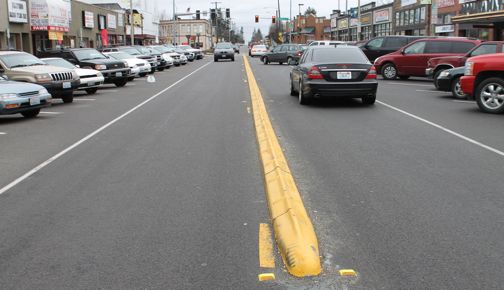
One day a few months back, the raised dividing line on 16th SW in downtown White Center all but suddenly appeared after the street was resurfaced. Many in that area wish it would suddenly, or not-so-suddenly, disappear. That was a big topic at Thursday night’s meeting of the North Highline Unincorporated Area Council.
THE DIVIDER: King County Department of Transportation’s Mark Mitchell was at the meeting to address those concerns and other traffic-related issues. He said the intent was to reduce the number of cars darting back and forth across the lanes to finish parking, and therefore to reduce crashes, which he said other tactics including “enforcement” hadn’t reduced.
What enforcement? asked Jesse Lovell of Company. Mitchell said it had been requested; Jesse and Uncle Mike’s Superlicious BBQ co-proprietor Elizabeth Gordon both insisted they had never seen any. In fact, they said, the barrier had brought new problems, especially traffic slowdowns when large trucks bring deliveries, since they can’t park in the middle of the street any more. Mitchell listened to the complaints and said that’s why he had come to the meeting – to find out about the kind of effects they couldn’t plan for. He said he would take the complaints back … but no promises.
NHUAC member Liz Giba voiced a concern about the barrier making the mid-block crosswalk less visible, and raising the chances of a crash.
ALCOHOL MEMO: The King County Sheriff’s Office is pursuing a new idea to crack down on derelict drinking, according to Storefront Deputy BJ Myers. It’s an idea that Chief Deputy Steven Strachan deployed in the Kent area, and is now pursuing in White Center. A memo to three distributors, dated February 10th, is as follows:
The King County Sheriff’s Office is seeking the cooperation of the beverage distribution companies that serve retail businesses in White Center to partner with the Sheriff’s Office in a voluntary restriction on certain alcohol sales practices that contribute to an unsafe neighborhood and poor business environment. Merchants, neighborhood councils, and citizen groups have made it clear that the problem of chronic intoxicated persons in the local business district is a primary concern, and thus, a primary concern of the Sheriff’s Office.
This problem has existed in White Center for years and is viewed as a major hindrance to the success of area businesses. The White Center Chamber of Commerce is one of many groups that has attempted a “Good Neighbor Agreement” program with retailers selling high-gravity alcohol to chronic inebriants, but none of the programs have been successful. Therefore, it is the belief of the Sheriff’s Office that a structured community partnership approach will more appropriately address the problem of chronic public intoxication in White Center.
You are being asked to participate in an alternative to a mandatory government-imposed restriction, such as the Alcohol Impact Areas enforced by the Washington State Liquor Control Board. By working with the Sheriff’s Office to identify and implement a moderate but meaningful restriction on the sale of certain products, your company will set an example of positive, community-focused, cooperation that the neighborhood will notice. The Sheriff’s Office is interested in restricting only products principal to the problem of chronic public intoxication so as to maximize benefit to the neighborhood, including beverage retailers.
As a beverage supplier to retailers that sell high gravity alcohol in White Center, your company can be an influential advocate of responsible business practices. The Sheriff’s Office hopes you will choose to be a part of this effort to encourage voluntarily restricted responsible business practices by White Center retailers.
Deputy Myers asked for NHUAC’s support, and they said “of course.” He says he hopes to go to retailers soon with distributor reps to talk about a ban on “high gravity” sales between 6 am and 1 pm; he stressed repeatedly, this is for retail outlets, not bars. The idea is to disrupt the cycle of how chronic alcoholics buy and consume. If all goes well, this could start by early April.
BURIEN UPDATES, INCLUDING ANNEXATION: City Manager Mike Martin said it’s still looking pretty good for the annexation process to proceed, since the sales-tax credit remains in the current version of the state budget (without it, the city has said it will call the process to a halt). If the budget is finalized with the credit still available, Martin says, he’ll go to the Burien council and ask them to move ahead (which would involve setting an election date). He also talked about newly hired Highline Public Schools Superintendent-to-be Dr. Susan Enfield, saying he was impressed by her and her “intelligent approach” to many of the issues where the city and school district intersect.

 Just last night,